

|
The Following Reviews
present what we consider to be some of the best
martial arts books ever published. You may not agree,
and we respect differing opinions. We are coming at
this from the perspective of martial arts (essential
concepts), tactics, and warrior (as in human) values.
Many titles were considered, and many, though
outstanding are not included. This presentation is not
meant to be comprehensive, and by intent, some
common bestsellers are ignored (Frankly, they’ve
already been discovered). Consider these
to be little gems that you might not have found, until
seeing them here. Titles are presented in
alphabetical order. For those with a
burning need to learn what we consider to be the
best martial arts book ever published, click here. Please...if you like coming, lend your support! If you benefit from what you find here, show your appreciation with a contribution. Doing so will assure our continued presence on line, and expansion into new areas of interest over time. We have many plans and ideas for the future, but will require significant upgrades in video recording equipment, software and computer hardware, on top of the increasing expenses for web volume and throughput. As it stands, we are extended to the limit of available resources. Cast your vote with a donation! WE REALLY NEED YOUR HELP!!!
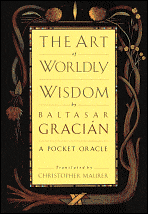
A Pocket Oracle 182 pages Author: Baltasar Gracian; translated by Christopher Mauer ISBN: 0385421311 Copyright 1992 by Christopher Mauer There are many great books we can look to for inspiration. Most of you have already read Musashi's Book of Five Rings or Sun Tzu's Art of War, Machiavelli or even The Rogue Warrior. Baltasar Gracian was a worldly-wise Jesuit priest who undertook a careful observational study into the norms of 17th century Spain. He categorized qualities and characteristics conducive to success, power and influence and also, those which were not. He then distilled his findings into this collection of 300 aphorisms, which in effect address the gamut of strategies underlying human interface. Some of these aphorisms take time and deep meditation before revealing their truth. Some qualify as tactically "offensive," while others would be the countering "defensive responses." In effect, Gracian compiles his observations into an objectively presented format, filtered through his Christian Jesuit orientation, while respecting the reality that each strategy (Yang) has its counter-move (Yin). This volume is for some, not for others. If you liked Musashi's Book of Five Rings, you might also enjoy this. The subtitle, "A Pocket Oracle," may be somewhat misleading. This is primarily a book on human psychology, perhaps philosophy, with an emphasis on didactic reasoning. The volume has nothing to do with prediction nor is it an oracle of any measure.
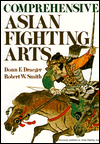
Also known as Comprehensive Asian Fighting Arts 248 pages Authors: Donn F. Draeger and Robert W. Smith ISBN: 0870114360 Copyright 1969 by Kodansha International Ltd. In 1969, when martial arts was just taking root in the continental United States, very little was known of other arts outside the popular categories of Judo, Karate and Kung Fu. Along comes Donn F. Draeger and Robert W. Smith with their publication of Asian Fighting Arts, literally providing our first broad glimpse into the mind-boggling array of fighting arts springing from Asia. As I understand, Draeger was a retired United States Marine Colonel who ultimately made Japan his permanent home, where he continued researching, practicing and instructing in the arts, particularly Judo and the weapons arts. Many who worked with him considered him to be a master-level martial artist. He certainly was a master level historian. Much the same can be said of Robert W. Smith, who stood at least equal to Draeger with respect to the Chinese arts, after spending many years researching and studying on Taiwan. This is a history book. What's remarkable is that it is an excellent history book, well researched and for the most part one that has withstood the test of time without assault on its objectivity, accuracy or integrity. Anyone who spends four or five decades in the martial arts will know as fact how history can be undone and recreated, then sold into nicely packaged parcels for general consumption by the masses. I remember hearing a quote from Draeger to the effect that happiness in life is being able to find what you love most, then figuring out a way to make money doing it. He did, and stands as example for us all. This book is the starting point for anyone seeking a serious and well-documented history of martial arts and their evolution through multiple cultures.
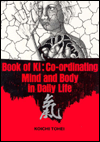
128 pages Author: Koichi Tohei ISBN: 0870403796 Copyright 1976 by Koichi Tohei Master Tohei was a student of Morihei Ueshiba but established his own identity as a master of, teacher about, and propagator of Ki awareness. Master Tohei's insights are singularly unique and will take you far down the path of developing your own personal Ki (or Chi if you will) without all the nonsense others may subject you to. In this volume, Tohei takes his four basic principles of Ki, makes sure you understand how to apply them, informs you that upholding any of the four principles upholds them all, violating any violates them all, then presents his treatise on how Ki can become a direct influence in your everyday life by reestablishing the natural connection between mind and body. Every martial artist should be personally familiar with Tohei's four principles of Ki.
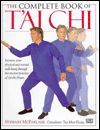
120 pages with photographs and illustrations Author: Stewart McFarlane ISBN: 0789414767 Copyright 1997 Darling Kindersley Limited, London Text Copyright 1997 Stewart McFarlane Publisher D.K. Publishing, Inc., New York, NY There once was a T'ai Chi Chuan Master named Cheng Man Ch'ing. Professor Cheng was a personal student of Yang Ch'en-Fu, recognized by many to be the quintessential T'ai Chi Chuan master of the 20th Century. Professor Cheng, a true renaissance man, practiced Chinese medicine in addition to his T'ai Chi Chuan but was also renowned as a painter, poet and calligrapher. Though few people will admit anyone as being the peer of Yang Ch'en-Fu, those who knew Professor Cheng recall his abilities and insights with awe, and he is generally considered to be among the greatest and certainly most influential T'ai Chi Chuan masters of the 20th Century. He is singularly known for creating the simplified version of the Yang long form (108 positions) into the Yang short form (37 postures). Within the universe of Chi Kung and T'ai Chi Chuan, techniques, their format, practice and sequencing are sacrosanct. T'ai Chi Chuan represents a quintessential distillation of the Chinese holistic sciences, philosophies and metaphysical insights. Its proper practice has consistently been shown to have life-changing impact and import on its practitioners. Simply stated, it is the grand ultimate archetype which propels the form manifested in all physical movement. Professor Cheng’s condensation of the original form was not at first well received. Even today, there are masters who chose not to mention his name or to make any reference to the Yang short form. It speaks of Cheng Man Ch'ing’s particular genius that one-half century after its creation the short form is now generally universal in its practice and is considered to provide essentially the same universe of benefit as the long form. This book presents the short form. You can't learn T'ai Chi from a book! However, if it were possible to learn T'ai Chi or the short form from a book, this would be an excellent starting point. If you are genuinely interested in learning T'ai Chi Chuan and have identified someone who teaches the short form, this volume as an adjunct will help you to learn in three months what otherwise would take a year. That's not to mean you can learn T'ai Chi Chuan in a year. But...it’s a start!
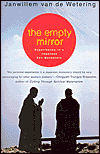
Experiences in a Japanese Zen Monastery First published in the Netherlands under the title: DeLege Spiegel 160 pages Author: Janwillem Van de Wetering ISBN: 0312207743 Copyright 1973 by Janwillem Van de Wetering I am old enough to remember before TV, then it came, followed by color TV, space travel, calculators, etc. There was a wonderful time in our history when you could travel virtually anywhere and not need to be fearful of crime or violence. Within my personal history are periods where I hitched and rode the rails and had some amazing adventures (and predicaments). However, I can't hold a candle to Janwillem Van de Wetering. Imagine, being a young person in the throes of wanderlust, having already traveled Europe and South Africa, then deciding to explore Zen, sailing to Japan, knocking on the door of a temple, interviewing with the master and being accepted. That's just the beginning of Van de Wetering's story. In my readings into Zen, nothing compares to The Empty Mirror. The book has the stark ring of authenticity, and the reader is left feeling as though he shared bodies with the author as the remarkable experience unfolds. Sadly, the story ends with the author's disenchantment over his struggles and a request to leave the temple. He takes a parting message from his master that the whole planet is a forge and a school where the sleeping are woken up. Van de Wetering is "now a little awake, so awake that you can never fall asleep again." At book's end, we are left puzzling over what becomes of our hero, with whom we have developed a near-fraternal link. Though Van de Wetering was a younger man at the time of this experience, he subsequently went on to considerable success as a mystery writer (with a Zen slant) and to a lessor extent, as a writer/commentator on the Zen experience.
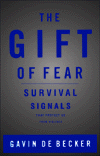
Survival Signals that Protect us from Violence 334 pages Author: Gavin De Becker ISBN: 0316235024 Copyright 1997 by Gavin De Becker You may never have heard the name Gavin De Becker, but he is well-known within certain circles as being a pioneer in the formal categorization of what constitutes genuine threat. How many times have you heard after a catastrophic act of violence: "How did we fail to see this beforehand?"; "No one could have foretold this was going to happen,"; "I knew something wasn't right about the person, but I ignored my instincts,"; "He was a normal and quiet neighbor in all respects ... I certainly couldn't have seen this occurring,", etc. ... etc. ... etc. This book presents De Becker's observation after a lifetime of study that each of us is equipped with all the instinct and intuition we need to produce and identify clusters of survival signals which are constantly there to serve us in addressing threats to our person and safety. Many of us simply shut these signals off by ignoring them or not giving them the credence they deserve. De Becker walks you through the process (citing numerous examples) of what to look for, how to identify it, how to trust what your instincts are telling you and how to respond. The book is eminently readable and belongs in every martial arts library.
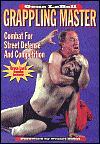
Combat for Street Defense and Competition Previously published as Pro Wrestling Finishing Holds 159 pages with photographs Author: Gene LeBell ISBN: 0961512628 Copyright 1992 Pro-Action Publishing I'll share a little secret with you. Most people know of my skills with weapons and as a stand-up fighter. Generally, they are surprised and usually impressed when they see what I can do on the ground. Inevitably, they will ask whether I studied Judo or perhaps Jiujitsu or some other grappling art. I merely respond, "Gene LeBell!" I discovered Grappling Master by accident while browsing through a display at All Martial Arts in Federal Way, WA. The book was nicely illustrated with what I considered to be excellent descriptions of the techniques accompanying each photographic sequence. Additionally, the descriptions and techniques were organized so you could get the entire concept without having to flip pages at any point in time (a very smart approach targeting those of us learning techniques with the book sitting flat beside us on the ground -- flipping pages can be a nuisance). I had known and heard of Gene LeBell from the years past. He was already a wrestling champion before I started in the martial arts (capturing AAU Judo championships in 1954 and 1955) and was a prominent and notorious professional wrestler during the barnstorming days of the 60's and 70's. I remember seeing him on television, also on the Jack Benny Show. In addition to his other exploits, LeBell further established himself as a Hollywood stunt man, and if you pay attention, you'll see him doing cameos and walk-throughs in many action adventure flicks. LeBell apparently also took his road-show south of the border with equal success and was even recognized for his diverse experiences when selected as the referee for the Muhammad Ali vs. Antonio Inoki boxing/wrestling match in Tokyo (check your history books on this one). In short, Gene LeBell is the real deal. He has spent a lifetime researching, practicing, devising and improving the art of grappling to its highest levels (read that to mean self-defense). People who recognize his skills and who have come to him for personal instruction read like the martial arts hall of fame. He is universally loved and respected and is the definitive authority on locks, cranks, chokes, crushes, pressure-point applications and the fine art of using pain and claustrophobia to subdue an opponent. Making the purchase, I was even more delighted when I brought the book home and did my first read-through. It opened a new dimension in my study of the martial arts, and I literally carried the book around for an entire year practicing with Black Belts whenever I could until I learned all of its techniques. Even today, I know the book front to back. Now you'll find good books on Judo, and Jiujitsu, and other arts such as Hapkido, Aikido, Chi Na, etc. They all have their own well-regarded systems of grappling and control techniques. Gene LeBell is the swizzle that makes the cocktail work. There is a difference between intellectually understanding a technique and being able to do it "on the fly." For me, "on the fly" started by learning everything Grappling Master had to offer. Think about it, for the price of a meal, you can take your martial arts to the next dimension. Buy this one while it's still in print! SUPPLEMENTAL REVIEW NOTES -- GENE LE BELL Accompanying the original Grappling
Master book are a series of three videos wherein
Mr. LeBell portrays many of the moves set out in Grappling
Master and later in Grappling World (The
Encyclopedia of Finishing Holds).
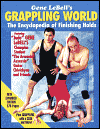
(The Encyclopedia of Finishing Holds) 520 pages Author: Gene LeBell ISBN: 0967654319 Copyright 1999 by Gene LeBell Publisher's information not available Before reading further, it would be a good idea to check out our review on Grappling Master, also by Gene LeBell. In a way, this is not unlike a child finding himself locked in a candy store after closing. After developing a taste for LeBell's techniques by going through his previous instructional, we hoped for the day he would dig further into his limitless arsenal and present more of the same. The Encyclopedia of Finishing Holds leaves no doubt that LeBell, though in his sunset years, remains one of the most fertile and creative martial arts minds this side of the Pacific. Gene LeBell does not pretend to be a historian, and his job is not to pontificate. He knows what he knows based upon his experience and his diligence in working very sophisticated techniques into executable formats. What you see in professional wrestling merely skims the surface of what this gentleman has been doing his entire life. As was the case with Grappling Master, The Encyclopedia of Finishing Holds takes a sequence or concept and lays it out on a single opened section of the book. That means you don't have to go flipping through pages trying to follow while executing. You lay the book flat, look and go from start to finish. By my reckoning, the book celebrates a life-time in the martial arts, particularly grappling. For many, it will be "the missing link" in their own personal practice. This book is a must have in every martial arts library. If you're looking for inspiration and insight into the grappling arts and need a road map, but don't want to spend the next several years in Brazil, this is it. I simply cannot overstate the direct impact this gentleman has had on my own skills and those skills of other Black Belts of my acquaintance -- using nothing but these two volumes as sources of reference. In closing, I should note that almost anything by Gene LeBell manifests in some form this gentleman's limitless sense of humor. In addition to being one of the most informative texts you can spend your money on, Grappling World is a "kick" to simply read and visit. Gene LeBell is forever looking for opportunities to bring humor and outright guffaws into his presentation, and that alone separates him from the many masters who sometimes come across as though being raised on sulfuric acid and lemon juice. At times, his presentation borders on pure "camp." I mean that as a compliment! SUPPLEMENTAL REVIEW NOTES -- GENE LE BELL Accompanying the original Grappling
Master book are a series of three videos wherein
Mr. LeBell portrays many of the moves laid out in Grappling
Master and later in Grappling World (The
Encyclopedia of Finishing Holds).
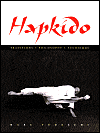
(Traditions, Philosophy, Technique) 1135 pages Author: Marc Tedeschi ISBN: 0-8348-0444-1 Copyright 2000 by Marc Tedeschi Published by Weatherhill, Inc. How does one even begin to review a book of this scope and sophistication? My first inclination is to pronounce it to be the Holy Grail of martial arts instructional texts and to urge you to buy it without a moment's delay. The suggested retail price is $80, but the book can be had for less from various sources. Frankly, this book would be a bargain at five times the suggested retail price. When I received my copy, the first distinguishing factor was its size, literally requiring two hands to hold. Within its 1,135 pages, are more than 9,000 photographs (each and every one of high quality) and over 2,000 martial arts techniques covering areas such as strikes, kicks, blocks, avoidance, holds, locks, chokes, throws, falls, take-downs, tumbling, and assorted weapons, including knife, short stick, long staff, cane, sword, rope, common objects and defense against hand guns. Within the text is an extensive instructional on anatomy, pressure points, meridians, itemization of accu-points with cross-references, including extensive supporting drawings and diagrams (diagrams and tables also support the photographs throughout the text), bringing a new level of clarity and intellectual precision in presenting previously "too complex to describe" concepts and techniques. I have never met Marc Tedeschi (who describes he is a 5th degree Black Belt in Hapkido) nor do I receive any benefit for promoting his book. It is simply a monumental accomplishment, nothing less, and belongs in every library. Having photographed and published myself, I look at his extensive array of photographs and marvel that they were taken on Plus-X Professional 2&1/4 film using Hasselblad cameras and then scanned for printing. For those who are novices to the business of producing martial arts texts, that requires a team of people with extensive commitments of time and energy, with extraordinary levels of coordination among various schedules, while trying to find places appropriate for the photographic sequences as well as processing hundreds, possibly thousands of rolls of film, then sitting for many, many hours scanning them one at a time, cropping each and every one, rearranging into tables, text and formats, etc., etc., etc. -- you get the picture. My hat is off to this man! That doesn't even touch upon the extraordinary narrative text supporting the entire volume, which by my measure is objective, informative and of consistently high quality. The marginal notations relate the author originally intended to complete the project within one year but ultimately took six entire years, and by the end, he was doing nothing else. Marc Tedeschi gives new meaning to "going the distance." The only other comment I can add is that the book, though on the surface a Hapkido text, goes far beyond Hapkido in terms of applicability to martial arts of all styles. I remember meeting a Hapkido master once and questioning him, "What is Hapkido?". He responded, "Hapkido is everything!" You can spend years finding things in Tedeschi's book which will broaden and enhance your own personal practice, whatever that may be. Trust me on this. This is the one! Title: Hapkido 767 pages with photographs Author: Dr. He Young Kimm ISBN: None Available Publisher: Andrew Jackson College Press Baton Rouge, LA Copyright 1991 by Dr. He Young Kimm For some years prior to the publication of Marc Tedeschi's Hapkido (see review), we considered this volume as setting the standard for references on the art of Hapkido. Clearly, Tedeschi's approach has been to get everything in one place at one time. Master Kimm has a different focus, dedicating this volume in large part to presenting an overall history of Hapkido, but particularly the presentation of Hapkido as promulgated by Grand Master Ji Han-Jae. Each stands on its own as a reference source. Even the techniques, though clearly bearing the imprint of Hap Ki Do, vary considerably. At the end of the day, each of these masterpieces has a unique focus, and can stand on its own. Master Kimm shares his ambition is to publish five master volumes on Hapkido (one of which will be dedicated to Kuk Sool; another to Han Mu Do-Do, Dr. Kimm's own system). The approach here is to lay out a history of the art and its multiple iterations and to formally define with photographic examples and detailed explanation the requirements for advancement through Fifth Degree Black Belt. The volume is quite large, generally requires two hands to read and hold, and the photographs are of excellent quality and relatively large format. There is no mistake as to what is being communicated. In addition to empty hand techniques, the volume presents self-defense from unusual positions, short stick, long pole, cane, sword, rope, knife and stone throwing and to some extent healing and revival techniques. Our impression is much of what is presented would have value to martial artists of any style or background ... for example, the presentation of cane techniques alone justifies the cost of the book. Unfortunately, the volume is somewhat difficult to find ... basically, if you see it and if the price is right, pick it up. I have heard the suggested retail price is $90; I picked up my copy (new) for $52. Knowing the immense costs that are involved in producing such a massive volume and the limited prospect for sales in the aftermath, I can't imagine that Grand Master Kimm breaks even on his investment even at the $90 price tag. For Dr. Kimm, this is clearly a labor of love and a manifestation of his discipline and dedication. Without his effort, Hapkido would be a lesser art. If you can't find the book through normal channels, you may wish to contact: The Han Do Group 4816 Jamestown Ave. Baton Rouge, LA 70808 Telephone: 225-924-2837 FAX: 225-924-4054 E-mail: hanmudo@intersurf.com
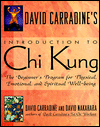
The Beginner's Program for Physical, Emotional and Spiritual Well-Being 173 pages with photographs Author: David Carradine and David Nakahara ISBN: 0805051007 Copyright 1997 by David Carradine and David Nakahara I suppose someone will object over my inclusion of any David Carradine work in a recommended list of martial arts reading. My own impression is Mr. Carradine takes considerable misguided heat for his efforts in popularizing the arts. Of course, you'll remember him as Kwai Chang Cane in the classic Kung Fu series and its modern day successor. There are no pretenses regarding his experience with the martial arts. His background was minimal when he landed the role of Kwai Chang, qualifying primarily as a professional actor. Bruce Lee was stunned at not being given the opportunity to play Kwai Chang. He was mortified it went to someone whose martial arts knowledge and repertoire were nothing more than a spark compared to his own. Lee of course went on to greater accomplishments, perhaps motivated in part by his failure to land the coveted role of Kwai Chang Cane. Mr. Carradine really makes no claim to anything except that once exposed to the martial arts and the Oriental philosophies, he undertook a life path of continuous exploration. He has come quite far down that path and would certainly be a ranking Black Belt in any system which recognized his efforts, diligence and achievements over several decades. Much of what he produces for general dissemination is in the category of "martial arts and/or philosophy for the millions." My belief is research and study into Chi Kung should be part of everyone's path. The problem is if you want it, someone will appear, ready to sell it to you at considerable cost. You can find and sign up for Chi Kung programs that will take you from here to the end of your time with continuous classes and associated expenditures on videos, tapes and certifications ... all of which have some degree of merit for what they represent. There’s no limit to how far you can take that path. Remember, we're supposed to be living lives here, aren't we? I have heard that on mainland China, Chi Kung psychosis is a recognized psychiatric ailment. That said, I expected to find this offering by Carradine and Nakahara to be no more than Chi Kung for the masses, and in some respects, it is that. However, on close reading, it reveals itself to be much more. What Carradine and Nakahara are presenting here is a concentration of everything each of us really and truly needs to know about Chi Kung in a format which is consistent with prevalent teachings on how to safely practice Chi Kung with positive benefit to the practitioner. Yeah, I know it's a mouthful, but that's what it is. Really, the choice is up to you. You can spend $1,500 next year on tapes, courses, texts, books and diagrams. Or ... you can buy this book. My suggestion is that you go with Carradine and Nakahara for the moment. If you feel you need more, reach for your wallet!
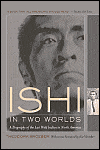
A biography of the last wild Indian in North America Author: Theodora Kroeber ISBN: 0520229401 Copyright 1961, 1976 by the Regents of University of California This isn't truly a martial arts oriented story, but then again it is. It deals with actual events, resulting tragedy and the impact of one culture on another. It relates to compassion, love, loss and forgiveness. It recalls a place in time where nature was pure and bountiful and a people who integrated perfectly with the environment and were cradled within that relationship. It documents the modern-day loss of Eden and its replacement with omnipresent technology, and unbridled development. The story is true and impeccably documented and reads far stranger and stronger than any conjured tale. Ishi is the last of the Yahi Indians, a stone age tribe which historically inhabited the Deer Creek country of Northern California. He entered our civilization as the "wild man" of Oroville on August 29, 1911. Faced with starvation, he was discovered in the corral of a slaughterhouse and incarcerated. It was only after the intervention of several anthropologists and linguistic experts that even rudimentary communications unfolded and confirmed Ishi to be the sole remaining member of a stone age tribe believed to be extinct. It is too easy to forget that much of what is now considered to have been uninhabited wilderness was in fact home for many tribes of indigenous peoples. We know of confrontations with fierce tribes, particularly on the Eastern seaboard and the Plains. Tragically, ample evidence exists of other, non-violent tribes, who before advent of civilization existed in near complete harmony with their environment until contacting the plagues and demons of the outside world. These populations simply diminished and/or disappeared, and in some instances, were exterminated. The story of the Yahi speaks for all Indians who fell prey to the latter course of change. Despite starvation and the terror of having lived through the murder of his family, Ishi was able to bridge briefly into the new culture, where he learned to love and befriend his benefactors and protectors. In his final years, Ishi became one of the more recognizable figures in the Bay area, and he remained as an anthropological study resource for University of California at Berkeley, where he demonstrated with amazing insight, confidence and dexterity the many skills and awarenesses still within himself that had already passed with the Yahi. The final link of this tragic story is that Ishi, choosing to remain in the new culture, inadvertently chose to expose himself to a host of diseases foreign to the Yahi. Ultimately, he contracted tuberculosis and passed on March 25, 1916. Those who knew him grew to love him dearly and have told his story in many forms over the decades since. All who were close to him were touched by his life and devastated by his death. You will understand, from your own sense of loss, after reading this book. Compassion is martial arts in its highest form. Title: Isshinryu Karate Author: Steve Armstrong As told to: Jay Alevizon ISBN: (none available) Copyright: 1984 DLAW Publication, Tacoma, WA This book was one of the last major projects undertaken by Master Steve Armstrong prior to his subsequent deterioration of health and retirement from teaching. In the book, Mr. Armstrong relates the discovery of his ruptured brain tumor and his difficult road to recovery, which, unfortunately, was short-lived as the long-term effects of the illness returned to finally debilitate this once giant of a man. Master Steve Armstrong towers over Northwest Karate. Even today, it is impossible to attend a tournament without directly witnessing traces of his teachings and principles evident in forms and fighting competition, as well as in standards of judging and excellence. Mr. Armstrong was a Texan and a former Marine, and he radiated both at all times. Over the course of his teaching career, he produced many of the first instructional and informational texts on Karate generally available in the continental U.S. Though some of his works would be considered primitive by modern publishing standards, they stand on their own as expositions of principles and movement from which a reader can gain true insight into the art of Isshinryu. I knew Master Armstrong personally for many years and will always remember visits to his Do-Jo by other instructors producing the response from Armstrong, "And what can I do to help you in your project?". Armstrong is a storyteller of epic proportions, and the only rub against him as a historian is that sometimes he would not let attention to objective fact get in the way of a good tale. This volume, if you can find it, provides a rare glimpse from a student's perspective of how Karate bridged from Okinawa to the continental U.S. You've heard it from others -- get it from the man! Title: The Isshinryu System 336 pages Author: Norbert Donnelly ISBN: None listed Copyright 1999 by Norbert Donnelly In many respects, this is to Isshinryu what Karate-Do Kyohan is to Shotokan. Isshinryu ("one heart method") is an amalgam of Shorin Ryu and Gojo Ryu, Kobayashi Ru and Okinawan Weapons Study. The style was conceived by Master Tatsuo Shimabuku, who continued to refine and evolve the concept throughout his life. As fate would have it, in its early years, Isshinryu was propelled to the forefront by numbers of U.S. Marines stationed in Okinawa who learned the style, then returned to teach it in the States. Prominent among them were Harold Mitchum, Don Nagle, Harold Long and Steve Armstrong. Serindipitously, these four returned to different areas of the continental United States, and Isshinryu developed four taproots, ensuring its future as a prominent style on the mainland. Isshinryu is singularly suited for the body habitus of typical Americans. It is a relatively upright style and favors a direct approach in applying power for purposes of self-defense. The fundamental elements can be learned over a period of several years (though mastering this system requires a lifetime), again favoring transmission within the sometimes difficult lifestyle patterns that are modern America. Prior to his passing, Master Shimabuku failed to leave a clear line of transmission. From his casual and supportive comments to several masters, it appeared he had transmitted authority for Isshinryu to multiple successors. After several decades, the system appears to have survived that unfortunate circumstance and is prospering, albeit without a unified center (a contrarian might argue the lack of a unified center to be the very factor which guaranteed its survival). Many observers within the martial arts community marvel at the resilience and popularity of Isshinryu in light of its somewhat troubled political past. From my perspective, what Shimabuku created stands on its own. This is a system which has become universal in many respects, and as the new generation of Masters moves forward in a reaffirmed spirit of fraternity, you can look for Isshinryu to prosper. Master Donnelly's presentation of Isshinryu is complete in that it presents the entirety of Isshinryu's empty-handed Kata, accompanied by a large format photographic layout with explanatory drawings and full descriptions. For a treatise that is essentially self-funded, it is a tremendous accomplishment. Master Donnelly also presents an extract on Isshinryu which is historically informative and appears to go beyond much of the other Isshinryu histories which are fundamentally anecdotal. Underlying his presentation of the empty-hand forms, Sensei Donnelly is careful to spell out the fundamental techniques which constitute the building blocks of Kata, including all of the necessary stances and hand and foot tools. This is a great addition to any collection, but for students of Isshinryu, it is a must have. The book is not available through distributors (at this time). I picked mine up directly from Sensei Donnelly, who was glad to autograph a copy at my request. He maintains a web-site www.isshinryu.com where you can obtain further information regarding purchase.
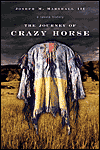
(A Lakota History) 310 Pages Author: Joseph M. Marshall III ISBN: 0-670-03355-3 Copyright 2004 Joseph M. Marshall III You may have heard of the Crazy Horse Memorial, the life project of Korczak Ziolkowski. The memorial continues as a work in progress, and the Ziolkowski family and their many supporters will someday bring full conversion of Thunderhead Mountain into the full embodiment of Crazy Horse. When responding to a mocking soldier's question, "Where are your lands now?" Crazy pointed and said, "My lands are where my dead lie buried." That is how he will be depicted in his final pose for the ages. Crazy Horse was inspired by a dream in his youth. After the vision, he had clarity of purpose as to his role and responsibility for the passage of his people through their darkest hour. Because of his vision, and the roar of thunder within it, his father recognized the special role his son, the "Thunder Dreamer" would fulfill. In the vision, Crazy Horse saw a stone at his ear, and took to wearing such a stone in life. It is said that when asked about it, he would replay, "I will return to you in the stone."...and he does so today, at Thunderhead Mountain. In this volume, Marshall does the nearly impossible. Working from legends, stories, lore, and the recollections of elders, he reconstructs the entire life of Crazy Horse, from the perspective of a Lakota. Here we see the emergence of a great leader, and warrior, within a culture where greatness is measured in terms of service to others, and respect for all creation. In his youth, he was known as Light Hair, because of the light color of his hair. His father was Crazy Horse, a respected medicine man and healer. After a warrior apprenticeship with Hump, Light Hair began to manifest his full potential, prompting his father to honor his exploits by passing the name "Crazy Horse" to his son. To further show his respect for his son's accomplishments, father adopted the unassuming name "Worm", which he held for the balance of his life. The thread of sacrifice, humility, generosity, love, responsibility, dignity, compassion, justice, caring, courage, intelligence, perseverance radiate from Crazy Horse in all aspects of his life. Herein, experience the Indian perspective on the Grattan Massacre, Harney's attack on Little Thunder's Encampment, the Battle of Platte River Bridge, the Battle of Hundred in the Hand, the Rosebud Battle, and the Greasy Grass Fight. Seeing these incidents from a new perspective, restores humanity to these historical tragedies, which from the perspective of the conquerors read as dramatic exploits of gallant soldiers. When soldiers enter the lands of another, there is always a second story, quite different than that propagated by the occupier. Though whites feared him for his warrior prowess, his own people knew, and continue to remember him as a leader who cared for his people, never putting himself or his needs before their well being. He never signed a treaty, nor did he concur with those other "leaders" who sought accommodation, and forfeiture of native lands to the westward migrating whites, and their government. He was assassinated at age 35 after entering Fort Robinson under a flag of truce stabbed in the back by an American soldier, betrayed in part by some of his own, jockeying for influence in the new order. With his final breath, he whispered to his father, "Tell the people they should not depend on me any longer."
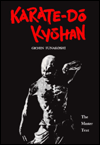
256 pages with photographs Hard cover, April 1973 Author: Gichin Funakoshi, Tsutomu Oshima (translator), noted by Shotokai ISBN: 0870111906 Copyright 1973 by Kodansha International Ltd. My feelings toward this masterpiece are nothing less than reverence, humility and affection. My personal copy is now nearly 30 years old, and though the once white pages are somewhat discolored, the book is just as sound as it was when purchased. In the vastly competitive and conflicted world of martial arts, Funakoshi is one of few who are recognized and revered by virtually all. It is his use of the word Karate and his allowing "empty hand" as a valid interpretation that forever defined the art as a path of awareness, personal growth and, lastly, self-defense. Funakoshi abhorred violence and the use of intimidation in relationships with others. He proclaimed for all his students "there is no first strike in Karate." In discussing "secret principles," Funakoshi relates the secret principle of martial arts is "not vanquishing the attacker but resolving to avoid an encounter before its occurrence. To become the object of an attack is an indication that there was opening in one's guard, and the important thing is to be on guard at all times." Funakoshi further explains "when there are no avenues of escape or one is caught even before any attempt to escape can be made, then for the first time the use of self-defense techniques should be considered." Funakoshi understood something lost to the modern world ... the hand and foot are the same as a sword. If your art is true, your self-defense is final and should only be used in a situation where all other alternatives are precluded. There was a time when a visit to the martial arts section of a bookstore produced only one or two titles. The release of this translation in 1973 was a conceptual breakthrough for many martial artists. At the time, it towered over other instructional texts and was the first genuine effort on the part of a master to present an entire system in its essence for study and understanding. Demonstrating the techniques and the 19 kata is Shihan Tsutomu Oshima, a recognized and renowned master who never left the path set by Funakoshi, and whose portrayal of techniques is nothing less than perfection, frame to frame. When I think of the movements and forms of Shotokan, images of Shihan Oshima are what my mind conjures. Funakoshi was a Confucian scholar, and his Shotokan Karate is imbued with a guiding undercurrent of ethic, compassion and humanity. His art is not about being a Ninja assassin or soldier of fortune. It is self-actualization in the finest sense. Within the volume are guiding comments by Master Funakoshi that deal with methods of practice, standards of conduct, pressure points and maxims. Don't expect verbiage. Master Funakoshi would say what he meant as though thrusting a spear. Two or three lines by Funakoshi are the same as books by others. This volume is a must have for any student of Shotokan. For the rest of us, it belongs on the shelf as one of the great expositions of a martial arts system.
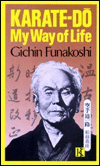
My Way of Life 127 pages Author: Gichin Funakoshi ISBN: 0870114638 Copyright 1975 by Kodansha International Ltd. Quite honestly, I was not impressed with this book on first reading. That was back in the 1970's ... after a year or two, I decided to give the book a second chance and re-read it. It was a much better read the second time around. Another year later, still not sure I was getting it, I read it a third time and discovered some nuances I had completely glossed over in my first two readings. This process continued for nearly a decade until I finally realized there was much more to this autobiography than met the eye. If anything, Master Funakoshi was a careful and meticulous man whose words are sometimes like harpoons driving right through the consciousness into some subliminal area where they implant and over a period of time register their effects. Though Funakoshi departed us in 1957 at the age of 89, his steady hand bridges across the span of time to new generations of martial artists in this rubix cube of a narrative which reveals itself only through quiet study and reflection. I make it a point to read it annually. The foundation of Funakoshi’s art is his extraordinary relationship with Masters Azato and Itosu, with whom he spent many years in direct tutelage, and whose influence he shares with the reader not through personal impression but by examples of how he interfaced with them and became imprinted. It was Funakoshi's demonstration of Karate (at the encouragement of his two mentors) before the Imperial Prince (this occurred in 1921 in the presence of Crown Prince Hirohito) which ultimately cleared the path for its introduction into Japan. By my calculation, Funakoshi was 54 years old when he travelled to Japan in 1922 and instituted the first formal instructional format of modern Karate. It was at this time that Funakoshi's first text, Ryukyu Kempo: Karate, was published and that he befriended and established a supportive relationship with Professor Jigoro Kano, founder of Judo. Keeping this in perspective, one should remember that by life expectancy standards of that era, Funakoshi was entering his sunset years when he first travelled to Japan and became the impetus for what subsequently unfolded as modern Karate. There are two events in his biography which receive little more than passing but sorrowful reference. First is the catastrophic Tokyo earthquake of September 1, 1923, where a great number of his students were lost. Funakoshi, without resources or wealth, and away from his native home, sustained an insurmountable setback in his efforts to establish Karate. Somehow he passed through this dark period, reestablished his teachings and propelled a whole new generation of students forward in the art. Then came the Second World War. Again, the great majority of his students, who often were first to volunteer in service to their country, failed to return. Bear in mind that Master Funakoshi was in his mid-70's when he had once again found it necessary to reestablish his art for posterity. No teacher ever sacrificed so much, with so little material reward, to establish a legacy. Funakoshi stands alone in the pantheon of masters for what he has created, preserved and passed on. Unfortunately, and this is not addressed specifically in the book, Funakoshi was not spared his share of detractors ... other masters who were strongly critical of his insistence on perfection of technique and Kata and his distaste for sparring competition. This, and other philosophical disagreements between himself and/or his students and other prominent martial artists inadvertently led to the formation and establishment of many of the other styles which have become associated with Japanese Karate. Likewise, there are many proponents of Okinawan Karate who will declare what Funakoshi taught was not true Okinawan Karate but an interpretation or aberration. Clearly, however, Funakoshi was of a singularly clear mind and disposition in his intent and his desire to follow the will and spirit of his two guiding masters. For that reason, we have Shotokan.
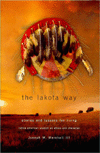
(Stories and Lessons for Living) 240 Pages Author: Joseph M. Marshall III ISBN: 0-670-89456-7 Copyright 2001 Joseph Marshall Our modern culture over-emphasizes exploitation as the sure path toward success. To attain our objectives we learn to master the material world, and each other, employing an intricate web of dominance, subservience, subterfuge, utilization, and then, disposal. The Lakota ruled the plains, until the Great Western Migration of the 19th century ended their nomadic lifestyle. Over the course of a millennium, possibly much longer, the great nations of the plains integrated harmoniously with their surroundings, and in so doing, with each other. The achieve this, skills of living were nurtured, developed, and cherished. To the extent you fulfilled your role, the nation (community) benefitted, and flourished. In martial arts, there must be a guiding philosophy. Without heart, spirit, and intelligence, we become thugs. Of that, the world has seen enough. It is simply too easy to lose one's way, surrounded as we are by the seduction and temptations of modern life. Using a combination of heritage, legends, stories, and actual events, Joseph M. Marshall III weaves a concrete portrayal of how those traits were valued in first American culture. For us, in a busy, harassed world, it is easy to lose the paths of humility, perseverance, respect, honor, love, sacrifice, truth, compassion, bravery, fortitude, generosity, and wisdom. Look here if you feel the need to restore your orientation. I would recommend exploring anything written by Joseph M. Marshall III. His words have the ring of authority and truth, emerging from a singular culture whose wealth is measured in its endowment of humanity.
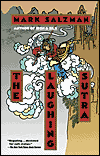
263 pages Author: Mark Salzman ISBN: 0679735461 Publisher: Knoph Publishing Group 1991 Mark Salzman first gained some degree of notoriety with publication of his first book, Iron and Silk, a compilation of vignettes and stories surrounding his experience as an English teacher on the Chinese mainland. This story was released as a movie of the same name, and though it did not achieve wide distribution, it remains as a remarkable first work of a blossoming artist and stands as one of the great martial arts films and cross-cultural commentaries I have yet seen. All of Salzman's output is characterized by a remarkable sense of curiosity, innocence and determination, which in many ways brings me back to feelings I had about the world as a child. He is forever exploring (as is evident in his several later works) but does so with fearless integrity and with the highest moral standard. The Laughing Sutra is another one of those rare novels which call out to be read yearly and are just as fresh after the tenth reading as they were at first. In a general sense, the story recalls the legend of Hanuman (the Monkey King) and his eternal tie to Prince Rama in the cosmic dance. There are many versions of the Hanuman legend (In China, it would be The Journey to the West) throughout the Orient. In every version, the Monkey King is the ultimate hero, characterized by physical prowess, mental discipline, spiritual purity, cleverness, wit, courage and indomitable spirit. Tempering his formidable assets is the fact he is a monkey and at times can be prone to mischief. Again, the common thread through all the legends is the journey of discovery, uncertainty and formidable challenge, which success depends inexorably upon the inherent connection between Hanuman and Prince Rama. In this story, Monkey lives in the form of Colonel Sun, of whom not much is explained but whose personal history and awareness blossoms like that of The Immortal. As the adventure unfolds, Sun is nothing less than a Chinese Hercules whose damn the torpedoes, full speed ahead mentality brings to mind John Wayne. With the exposition of Sun’s character, the reader is treated to some unique, frequently humorous insights into the impact of our modern world and lifestyle on an ageless spirit with impeccable history. Moreover, Salzman makes good use of Sun's simian appearance with frequent stunned reactions encountered on their journey. The story centers on the abandoned orphan Hsun-Ching, raised under the tutelage of his mentor, a Buddhist monk, who in his waning years wishes to achieve a single dream, finding the last remaining copy of the laughing sutra. The sutra, if read and understood, guaranteed instant enlightenment and awareness to the disciple. Hsun-Ching dedicates his life to the quest and with his simian-immortal cohort manages to escape the mainland and sneak into the United States, where their adventures unfold in San Francisco. Lest I give away the essential story (there are some twists), I will leave it to you to decide whether you need to know more. If so, you'll just have to buy the book. I will note that Colonel Sun exits the story by returning to his "sleep", which in his case means generations will pass before we see his next adventure. Truly a pity.
233 Pages Arthur: Renzo Gracie and John Danaher ISBN: 0-7360-4404-3 Copyright 2003 by Renzo Gracie and John Danaher This text stands almost alone in taking a "Top Down" approach to the presentation of its topic. It begins with a careful, but concise summary of classical Jujitsu theory and history, which integrates as well as I've ever seen, the warrior traditions of Japan, leading to the compilation and amalgamation of the various arts by Professor Jigaro Kano. Kano takes the arts into new directions of practicality, creating methods for practice and mastery which involve direct application of techniques in pseudo combat situations. While other arts are considered too dangerous to be practiced at full application, Kano is perfecting his Judo, where application by trial is the standard. Of course, this involves elimination of certain techniques, but what remains clearly proves its efficacy and merit. However, even Professor Kano had to re-assess after allowing challenges from proponents of the ancient art of Fusen Ryu. This art specialized in grappling and ground fighting, and presented a genuine threat to the dominance of Judo. After his Judo students were defeated at the hands of Fusen Ryu proponents, Professor Kano learned and adapted, essentially integrating the concepts of Fusen Ryu into his own teachings (in fact, Fusen Ryu appears to have completely assimilated into Judo and subsequent systems). The thread of Fusen Ryu radiates through the migration and exploits of ex-patriot masters taking root in the British Isles, Brazil, and elsewhere. It is in Brazil, where the Gracie family learns and perfects the system of ground fighting and grappling, now broadly evolved and known as Brazilian Jujitsu. The Gracies have a family tradition of putting their skills to the test. That meant challenges, competitions, combat, what have you. Over a period of decades, using their accumulated knowledge, they were able to articulate a strategic overlay to their fighting arsenal, which ultimately transformed their art into the modern standard by which other one on one combat arts must be measured. The strategic approach of this text, combined with the comprehensive overview of historical influences, and topped off with actual presentation of technique, make this a singularly unique martial arts resource. Lastly, I should add that Gracie Jujitsu continues to succeed at mixed martial arts competitions, and rightfully, the authors pay due respect to the efficacy of the system. Even so, their evenhanded approach recognizes the value of all martial arts, and shares their efforts to modify and improve even their own art as new challenges sometimes show that old theories have failed to meet the future. Title: Martial Arts Traditions, History, People 437 pages with photographs Author: John Corcoran and Emil Farkas ISBN: 0831758058 Copyright 1988 by W.H. Smith Publishers, Inc. There are few genuine historians or archivists in the martial arts. Much of what we see is anecdotal or revisionist, possibly sometimes even fantasy. This volume was compiled and organized before the advent of modern desktop publishing and must be recognized for the Herculean task it was. You can't help but to find fascinating extracts and information on virtually any page you flick to. As I am dictating, I have randomly opened to page 370 where there is a detailed biography on Elvis Presley and his lifelong love and dedication to the martial arts, including stints with teachers Ed Parker, Chuck Norris and Mike Stone. There were many occasions when I sat with Master Steve Armstrong and he would share the account of being flown to Las Vegas to participate in Elvis Presley's first Black Belt test. The account would eventually get around to Armstrong's closing comment that "Elvis was the real deal, ... and a damned nice guy to boot." Though not a true encyclopedia, the scope of this text is amazing, and any research into the martial arts or any of the major styles should begin here if only for the multiple cross-references as starting points. There is an extensive bibliography, and the volume is fully indexed. The only downside is that it is out of print and not in current distribution with the major sellers. It can still be found through secondary sellers and is often on the shelves of used book stores (what Philistine would let one of these get away?).
238 pages Author: Gregory Whincup ISBN: 0312141319 Copyright 1986 by George Whincup There is no end to the number of texts and references available on the I Ching ("sacred classic"). The common thread among them all is the 64 hexagrams or symbols which are the basis for identifying passages within the classic which are then utilized as a foundation for personal reflection and contemplation before undertaking action. There are many renowned scholars throughout Chinese history (and in modern China) who believe the I Ching is nothing less than the symbolic portrayal of the underlying forces, currents and codes which govern all of reality. A person skilled in use of the I Ching is a social scientist of sorts, but one who works exclusively in the realm of symbols, archetypes and interpretations. On the one hand, you can visit any Chinese market and find people willing to do an I Ching interpretation. They present as fortune tellers. On the other, no less an authority than Confucius played down the predictive capacity of the I Ching to emphasize its value as a contemplative tool. These lessons have spanned cultures and were even factors in the researches of Carl Jung in his efforts to identify underlying symbolisms inherently associated with the human entity. From my perspective, the I Ching is singularly unique. There is nothing like it anywhere for what it says and for what it aspires to be. You can get lost reading through the multitude of texts, many of which will lead you down a drawn-out path of pedantic exposition. Mr. Whincup brings it on home. He outlines the evolution of I Ching over the course of China's Bronze Age as the Zhou Dynasty replaces the Shang. He further articulates how the text represents in symbolic form the movement of an obscure Zhou noble to status of emperor. The translation is eminently readable, but Whincup is careful to ensure the reader leaves with the full understanding of how to apply the text, both as a metaphysical/philosophic study but also from the perspective of its mantric capacities.
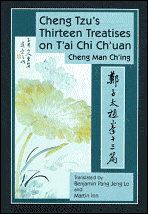
A simplified method of calisthenics for health and self-defense 135 pages Author: Cheng Man-Ch'ing ISBN: 0913028851 Copyright 1981 by Juliana T. Cheng Before reading further, you might wish to visit our review of The Complete Book of T’ai Chi where we touch upon Cheng Man-Ch'ing's impact and significance in the world of the martial arts, particularly on T'ai Chi Ch'uan. Basically, when Cheng Man-Ch'ing (now deceased) speaks, you should listen carefully. By the end of his life, he was well beyond the mere execution of physical movement in his understanding of form, and his words and writings are glimpses of the rarest insights into that void (Wuchi) from which springs T'ai Chi and the multitudinous manifestations of movement. Cheng Man-Ch'ing wrote this text approximately ten years after publishing Cheng's Thirteen Chapters on T'ai Chi Ch'uan . It was his impression that many found the concepts of the first book to be excessively complex, even out of reach. His response was this text, in some respects an introduction to the Thirteen Chapters, but in retrospect, a volume which has taken on its own significance and proportions. I caution this book may not be for everyone. You may even find the highly detailed descriptions of movement and posture to be a difficult read, if not boring. If that is the case, I would suggest that you ponder the photographs ... and recognize this man's posture would change to adopt to the weight of a fly if one happened to land. Fortunately, before his passing, Cheng either wrote or dictated his thoughts to and through enough venues so that much of what is significant has been recorded and preserved. He frequently emphasizes what he has shared constitutes less than a tenth of what could be said about T'ai Chi Ch'uan, but oh what a tenth it is!
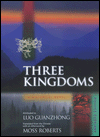
A Historical Novel 1096 pages Attributed to: Luo Guanzhong Translated from the Chinese with introduction and notes by Moss Roberts ISBN: 0520089308 Copyright 1991 by the Regents of the University of California This book is not for the timid. Within it you will find the Chinese equivalent of Robin Hood, Zorro, King Arthur, the Musketeers, cowboys, Indians, heros, cads, dukes, wizards, courage and treachery. The influence of this novel and its imprint on Chinese culture is universal. References to its characters and stories abound in Oriental imagery, art and theater and cinema. When you see children playing on the street, frequently they'll be acting out their heroes from the Three Kingdoms, just like you and I might have pretended for a moment that we were cowboy or Indian in some imaginary drama. Reading the book is no easy feat since you'll start out constantly referring to footnotes and appendices, if only to keep track of the initially unfamiliar names and who is who as the multitudinous plots unfold. This is the story of the disintegration of the Han Dynasty. Lest you not underestimate the significance of that event, even today, Chinese think of the Han as the quintessential Chinese. Korea refers to itself as Han Gup or Land of the Han. The transition from Han Dynasty into the warring states of the Three Kingdoms is nothing less than a disintegration of harmony and culture into chaos during a troubled period of Chinese history. Our heroes are Liu Bei (Xuande), Guan Yu (Yuschang), known today as Lord Guan or Kwan Kung, and Zhang Fei (Yide). While serving as soldiers, the three men become friends and swear lifetime loyalty and devotion to each other in the form of the Peach Garden Oath (named after the location). Liu Bei was a distant relative of the existing and final Han emperor. At the Peach Garden they swore to a common purpose where, though being of separate ancestry and heritage, they would be as brothers, combining resources to serve the emperor and protect the common-folk. Their vow included the stipulation that under heaven they would die the same day ... meaning that should one be slain the others would give their lives to avenge the loss. The story spans three generations, with the sworn brothers dedicating their entire lives to restoration of the Han Dynasty. Throughout Chinese culture, their sacrifices and loyalty are held as standards for conduct of all men, and their deeds are memorialized within the Chinese opera. Tragically, at book's end, the Han Dynasty is not restored, and the empire sinks fully into its warring period. There is a thread within the story that the Peach Garden Oath, commendable for what it was and in its execution, played some significant part in Liu Bei's ultimate failure (as leader) to revive the Han. Set to achieve victory, Liu Bei and Zhang Fei are stunned by the unexpected death of Guan Yu, the invincible warrior. Their focus broken, they set onto a spiraling path of poor tactical decisions, hoping to achieve retribution for their great personal loss. That course ultimately precipitates the disintegration of hope for restoration of the Han, ultimately, failure. Within Chinese history, the great admiration for the Peach Garden Oath and the relationship of the three sworn brothers is tempered by the awareness of its underlying link to disintegration of the Han. If you ever get to Chinatown and wonder what's behind those statues on the shelves, read this book.
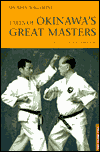
169 pages Author: Shoshin Nagamine Translated by: Patrick McCarthy ISBN: 0804820899 Copyright 2000 by the Estate of Shoshin Nagamine The late Shoshin Nagamine was a Master of Okinawan Karate Do and, wishing to accurately preserve and portray its heritage, personally set about to research and document the family lineages and histories of many of Okinawan's great masters, preserving them for posterity. Even as he was undertaking this process, it is clear from the text many of the records were already beginning to vanish, a considerable number were destroyed in the war -- making his accomplishment all the more difficult, but significant. Translator Patrick McCarthy appears in recent years to be filling the shoes of Donn Draeger as a genuinely serious, thorough and accurate historian of martial arts histories and traditions. Tales of Okinawa's Great Masters in many respects connects the dots between the stories you may have heard from your own teachers or from students of other styles. This book belongs on every shelf.
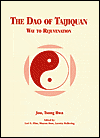
Way to Rejuvenation 286 pages Author: Jou Tsung Hua Edited by: Shoshana Shapiro, PhD ISBN: 0804813574 Published by: Tai-Chi Foundation, Warwick, NY 10995 Author Jou Tsung Hua introduces this treatise by sharing a history of deteriorated health which prompted, at the age of 47, his immersion into a lifestyle emphasizing good health and joy. He already had a successful career teaching math (with many mathematics books published in Chinese), but his personal focus underwent a major shift. He dedicated the following years of his life to practicing and ultimately mastering Tai-Chi Chuan and its sometimes difficult and esoteric concepts. Master Jou was a model of generosity with his knowledge, and he became a renowned popularizer of Tai-Chi Chuan in the United States. He originally shared his knowledge and lessons for free and later became the founder and director of the Tai-Chi Chuan Farm in Warwick, NY. I was fortunate to discover this text quite by accident. It called to me from the shelf of a discount book store in Tacoma. Frequently, my personal research into specialty areas of martial arts and/or philosophy will generate questions which remain unanswered for years. Then unexpectedly, I stumble upon the teacher or reference that guides me to the best answer or solution. I still remember lifting this volume off the shelf and thumbing its pages, realizing instantly that within were answers to hundreds of questions waiting patiently in my subconscious for years. I suppose a diligent student of Tai-Chi Chuan, residing in the Orient, being a native speaker and reader, would have direct access to a universe of knowledge on the art, its history and development. Much of that is not directly available to a Westerner. That may or may not be a disadvantage ... many of the teachers I've encountered have emphasized doing the form is the best answer to questions, adding the form would reveal itself with diligent practice over time. What Master Jou does is present in understandable English the essence of what is available to the native Chinese practitioner. The volume takes you through the roots of Tai-Chi Chuan in an articulate, informed and insightful fashion. He then ties the practice of Tai-Chi Chuan to its metaphysical foundations and philosophy, most importantly establishing its significant link to the I Ching, which according to Jou cannot be understated in its impact on the origin and development of Tai-Chi Chuan. Master Jou then takes the reader down the path of how to approach Tai-Chi Chuan, making recommendations on undertaking a meaningful personal practice. He presents the "classics," guiding works on the meaning of Tai-Chi Chuan, effectively integrating the thoughts of previous masters, and then relates his lifetime of practice to standards of measure for personal growth and development relative to what is ultimately attainable. After reading this book, I immediately undertook a search for Master Jou Tsung Hua and planned to dialogue with him and ask for opportunity to work with him if possible. Regretfully, my search led to a sad conclusion. Master Jou Tsung Hua (1917-1998) met his untimely demise on August 4, 1998, the victim of a tragic traffic accident.
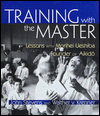
Lessons with Morihei Ueshiba, Founder of Aikido 139 pages with photographs Author: John Stevens and Walther v. Krenner ISBN: 1570623228 Copyright 1999 by John Stevens and Walther v. Krenner Morihei Ueshiba is universally regarded as one of the giants of 20th century martial arts. After a reported enlightenment experience in the spring of 1925, he went on to a lifetime of astounding accomplishments, crowned with the development of Aikido as an art of peace. It should be noted that Morihei Ueshiba was a renowned martial artist even before his reported enlightenment. Before the magic moment, he was already an awesome martial artist, capable of astonishing feats of ability and strength. But young Ueshiba was also shaped by other factors in his life. He was a follower of Onisaboro's Omoto-Kyo sect, with definite pacifist, anti-capitalist and anti-imperialist leanings and a world view of realty which included a back-to-nature lifestyle and martial arts training. This clearly put him out of step with pre-war Japanese convention, and in the mid-1920's, Onisaboro and Ueshiba, along with some other believers, embarked on a Mongolian adventure in search of Shambhala. They faced constant danger during that period, but Ueshiba's abilities were already going beyond the normal when he relates once being trapped in a volley of bullets but being able to avoid the bullets by seeing their trajectories as beams of light. Ueshiba felt that martial arts was a manifestation of universal love into the material plane. To him, this articulates as Aikido, which implied groundedness in a universal center. Most texts on Aikido read like courses in calculus. Undoubtedly, it is better to experience than to read about it. With most of what I have read, the essence of Master Ueshiba seems to disappear in the complexity. The author in this case puts Morihei Ueshiba right before your eyes in a remarkable series of exquisite photographs collected from his later years. It is one thing to read about a master but another thing completely, to see him up close and personal. Framing this remarkable photographic study is a nicely detailed synopsis of Ueshiba's history and path of personal growth, culminated by a presentation of quotations from the master which jump like lightning from the page as you ponder their many levels of meaning. Every great master deserves a book like this. Unfortunately, not every great master has students up to the task.
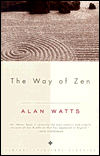
236 pages Author: Alan W. Watts ISBN: 0375705104 Copyright 1957 by Pantheon Books, Inc. If you don't know of Alan Watts, you should. Watts was born in England and lived a life that to many would be a dream. By the age of 16, he was writing essays on Zen in London; and, ultimately, as an editor, researcher, Anglican priest, lecturer, entertainer, dean and consultant, achieved a notoriety shared by few. His bibliography includes more than 20 books, but over the span of his life, he was recorded, taped and televised virtually everywhere he went, leaving a rich legacy behind which can still be found, or even heard on the Internet. He held a Masters degree in theology and an honorary Doctorate of Divinity in recognition of his work in comparative religions. Watts could quote from the Bhagivad Gita as readily as from the Bible, and his confidence and deep penetrating insight poured forth answers to those questions of mystery that we ponder for entire lifetimes. Watts appeared to have interest and love for virtually everything, was a recognized gourmet cook, would walk and chant, danced, was fascinated with archery and lived on a houseboat. Whenever I crossed his path, I left feeling enlightened (for the moment). Once I told somebody how I thought I finally understood reality after hearing Alan Watts talk. When the person asked me to explain, I stared blankly, referred him to Watts and added, "What he says!". When this book first hit the marketplace, Zen was a mysterious word of unknown significance. For many, this was their first journey down that path. It stands today as it did then, the finest introduction to the practice and path of Zen I have yet to see.
|
[Home] [About Us
] [Archie] [Concepts] [Contact Us]
[Gun
Fu Manual] [Kata]
[Philosophy] [Sticks] [Stories] [Web
Store] [Terms of Use]
[Video]
Copyright 2000-2024, Mc Cabe and Associates, Tacoma, WA. All rights reserved. No part of this site can be used, published, copied or sold for any purpose, except as per Terms of Use .